Showing posts with label Cryogenic Hydrogen Gas Chiller. Show all posts

Wednesday, September 2, 2026

Air Cooled Inverter Scroll Chillers: Working, Benefits & Industrial Applications

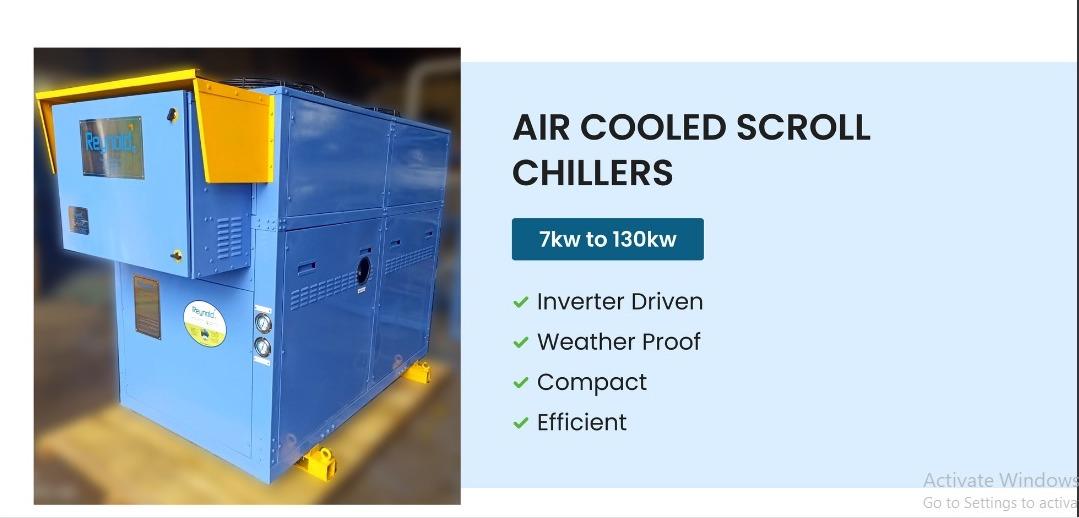
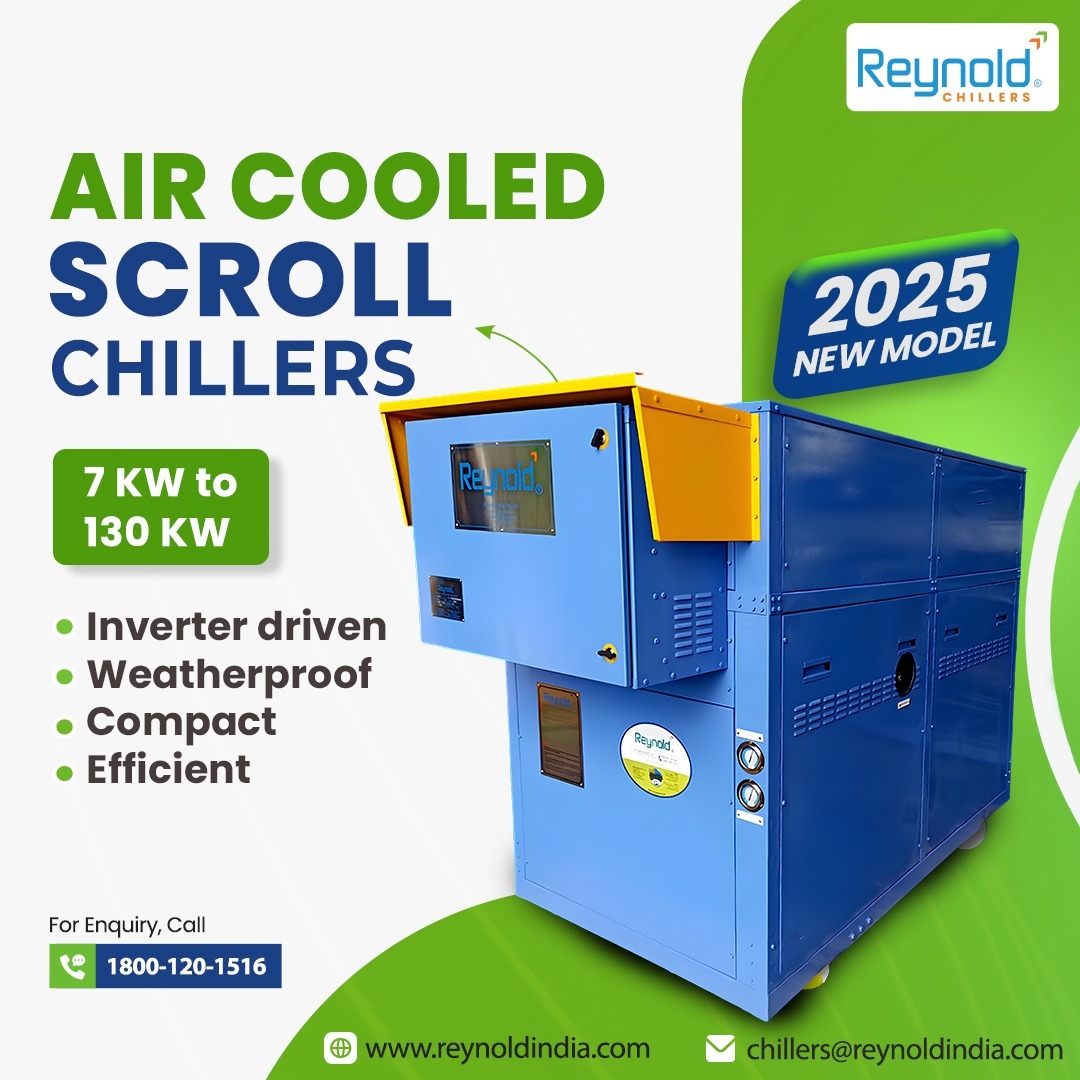
 When an industrial process needs reliable cooling without the complexity of a cooling tower, an Air Cooled Inverter Scroll Chiller can be a practical choice. These chillers are designed to produce chilled water for processes where temperature control, energy efficiency, and dependable operation are important. With inverter technology, the compressor can adjust its speed according to the actual cooling demand instead of operating continuously at full capacity.
1.jpg

What Is an Air Cooled Inverter Scroll Chiller?

An Air Cooled Inverter Scroll Chiller is a refrigeration-based cooling system that uses scroll compressors with variable-speed inverter technology. Unlike water-cooled systems, it rejects heat directly into the surrounding air through an air-cooled condenser.
The inverter-controlled compressor changes its operating speed according to the cooling load. During periods of lower demand, the compressor can reduce its speed, while higher loads require increased capacity. This approach can help reduce unnecessary power consumption and provide more stable chilled-water temperatures.
These chillers are particularly useful for factories, process plants, commercial facilities, and applications where a consistent cooling supply is required throughout the day

How Does an Air Cooled Inverter Scroll Chiller Work?

The cooling process follows the basic refrigeration cycle. Refrigerant absorbs heat from the process water inside the evaporator. The refrigerant then moves to the scroll compressor, where it is compressed and its pressure and temperature increase.
The hot refrigerant travels to the air-cooled condenser, where condenser fans remove the heat and release it into the atmosphere. The refrigerant then passes through the expansion device, reducing its pressure and temperature before returning to the evaporator.
The inverter continuously helps match compressor output with the cooling requirement. This is especially useful when the process load changes during production.

Key Benefits

One of the biggest advantages is better part-load efficiency. Industrial cooling requirements are rarely constant, so variable-speed compressor operation can reduce energy wastage when the required load is lower.
Other important benefits include:
  • Stable chilled-water temperature
  • Reduced compressor cycling
  • Efficient operation under varying loads
  • No cooling tower required
  • Easier installation compared with many water-cooled systems
  • Lower water consumption
  • Compact and practical system configuration
  • Suitable for continuous industrial operation
The actual efficiency and operating cost depend on factors such as ambient temperature, chilled-water temperature, load profile, system design, and maintenance.

Industrial Applications

Air cooled inverter scroll chillers can be used across a wide range of industries. In plastics manufacturing, for example, an Industrial Cooling System for Plastics can provide controlled cooling for injection molding, extrusion, blow molding, and related processes. Consistent cooling is important because fluctuations in process temperature can affect production quality and cycle times.
Concrete production is another area where controlled cooling is important. A concrete chiller can be used to cool mixing water or other materials when concrete temperature needs to be controlled, particularly in hot-weather conditions.
aircooledscrollchillers7kwto130kw.jpeg

Different industrial processes require different cooling technologies. A Cryogenic Hydrogen Gas Chiller, for example, is designed for specialized hydrogen-related cooling requirements and operates under significantly different process conditions from a conventional factory chiller.
Similarly, an RF dryer may require cooling of specific components or process equipment depending on the system design. Water Cooled Screw chillers and an Air Cooled Screw chiller may also be selected for larger industrial loads where higher cooling capacities or different operating conditions are required.
In agricultural and irrigation-related applications, Drip Irrigation Chillers may be considered where controlled-temperature water or specialized process cooling is part of the overall system requirement.

Why Proper Chiller Selection Matters

Choosing a chiller should not be based only on tonnage. The required cooling capacity, inlet and outlet water temperature, flow rate, ambient temperature, operating hours, installation conditions, and process load should all be considered.
For industries with fluctuating cooling requirements, inverter technology can be particularly useful because the system can respond more closely to the actual demand.


1. What is an Air Cooled Inverter Scroll Chiller?

An Air Cooled Inverter Scroll Chiller is a cooling system that uses scroll compressors with variable-speed inverter technology to produce chilled water. The compressor adjusts its speed according to the cooling load, helping the system operate efficiently when demand changes.

2. How does an Air Cooled Inverter Scroll Chiller work?

The chiller removes heat from process water through the evaporator. The refrigerant absorbs this heat, is compressed by the scroll compressor, and then releases the heat through the air-cooled condenser. The cooled water is then circulated back to the industrial process.

3. What are the main benefits of Air Cooled Inverter Scroll Chillers?

The main benefits include variable-capacity operation, good part-load efficiency, stable water temperature, lower water consumption, easier installation, and no requirement for a cooling tower. Actual energy savings depend on the operating conditions and system design.

4. Where are Air Cooled Inverter Scroll Chillers used?

They are used in manufacturing plants, plastics processing, food and beverage production, machinery cooling, HVAC systems, process industries, and other applications requiring reliable chilled-water cooling.

5. Can an Air Cooled Inverter Scroll Chiller be used for plastics processing?

Yes. It can be used as an Industrial Cooling System for Plastics for applications such as injection molding, extrusion, and other plastic-processing operations where consistent process-water temperature is important.

6. What is the difference between an Air Cooled Screw Chiller and an Inverter Scroll Chiller?

Both systems use different compressor technologies. An Air Cooled Screw Chiller is commonly selected for larger cooling loads and continuous industrial applications, while inverter scroll chillers are particularly useful for applications with varying loads where variable-speed operation can improve part-load performance.

7. Is a cooling tower required for an Air Cooled Inverter Scroll Chiller?

No. An air-cooled chiller rejects heat directly to the surrounding atmosphere through its condenser and fans. This eliminates the need for a cooling tower and condenser-water circuit.

8. Can these chillers be used for specialized industrial applications?

Yes, but the chiller must be selected according to the actual process requirements. Specialized systems such as a Cryogenic Hydrogen Gas Chiller, concrete chiller, or cooling associated with an RF dryer may require different temperatures, materials, controls, and refrigeration configurations.

9. Are Water Cooled Screw Chillers better than Air Cooled Inverter Scroll Chillers?

Not necessarily. The right option depends on cooling capacity, operating conditions, ambient temperature, available utilities, installation space, and required efficiency. Water Cooled Screw Chillers can be suitable for large continuous loads, while air-cooled inverter scroll systems can be attractive where cooling-tower infrastructure and water consumption need to be minimized.

10. How do I choose the right industrial chiller?

The selection should consider cooling capacity, required supply and return temperatures, water or fluid flow rate, ambient conditions, operating hours, process load variation, installation environment, and energy requirements. Proper engineering is important for achieving reliable and efficient operation.

11. Can the same cooling technology be used for drip irrigation applications?

Cooling requirements vary by application. Drip Irrigation Chillers should be designed or selected according to the required water temperature, flow rate, environmental conditions, and actual agricultural or process requirement rather than using a standard chiller without evaluation.

12. Why should I choose a customized industrial cooling solution?

Every industrial process has different cooling requirements. A properly engineered solution can be matched to the required capacity, temperature, flow rate, operating conditions, and available space, helping provide more reliable and consistent process cooling.

Conclusion

An Air Cooled Inverter Scroll Chiller offers a combination of reliable cooling, variable-capacity operation, and practical installation. It can be a suitable solution for industries that need accurate temperature control without depending on a cooling tower.
From plastics processing and manufacturing to specialized process applications, selecting the right chiller configuration can improve process stability and overall cooling performance. A properly engineered system should always be selected according to the actual process conditions and required cooling load.

Thursday, August 27, 2026

Cryogenic Hydrogen Gas Chiller: Advanced Cooling Solutions for Hydrogen Applications

As the global energy sector moves toward cleaner and more sustainable alternatives, hydrogen is gaining importance across transportation, industrial processing, energy storage, and research applications. However, handling and processing hydrogen efficiently requires precise temperature control. This is where a Cryogenic Hydrogen Gas Chiller plays a critical role.

Reynold India Pvt. Ltd. provides advanced industrial cooling solutions designed to meet demanding process requirements. With expertise in process chillers and customized cooling systems, the company focuses on delivering reliable temperature control solutions for specialized industrial applications, including hydrogen-related processes.

What Is a Cryogenic Hydrogen Gas Chiller?

A Cryogenic Hydrogen Gas Chiller is a specialized cooling system designed to reduce and control the temperature of hydrogen gas for industrial processes. Depending on the application, required temperature range, gas flow rate, pressure conditions, and process requirements, the cooling system can be engineered to deliver highly controlled low-temperature performance.

Hydrogen applications often involve demanding operating conditions. During compression, storage, transfer, testing, or refueling, the temperature of hydrogen can increase because of pressure changes and gas compression. Effective cooling can therefore become an essential part of maintaining controlled process conditions.

Unlike standard comfort cooling equipment, hydrogen cooling systems require careful engineering. The design must consider factors such as operating temperature, cooling capacity, pressure, heat load, gas characteristics, safety requirements, control accuracy, and continuous operation.

Why Is Hydrogen Gas Cooling Important?

Hydrogen is used in a growing range of applications, from industrial manufacturing to clean-energy infrastructure. In many of these applications, temperature management is necessary for efficient and controlled operation.

A Cryogenic Hydrogen Gas Chiller can help manage the heat generated during hydrogen processing. Controlled cooling may be required in applications involving hydrogen compression, gas handling, storage systems, testing facilities, and refueling infrastructure.

Proper temperature control can support:

  • Stable process operating conditions
  • Efficient heat removal
  • Controlled hydrogen gas temperature
  • Improved process consistency
  • Reliable operation of connected equipment
  • Accurate temperature monitoring
  • Better integration with specialized hydrogen processes

Every hydrogen application has different requirements. For this reason, selecting a cooling system based only on general capacity can be insufficient. The complete process duty should be evaluated before designing the chiller.

How Does a Cryogenic Hydrogen Gas Chiller Work?

The working principle of a Cryogenic Hydrogen Gas Chiller is based on the removal of heat from a process. The exact system configuration depends on the required operating conditions and the application.

In a typical engineered cooling arrangement, the refrigeration system absorbs heat from a secondary cooling medium or directly from an appropriately designed process heat exchanger. The heat is then transferred through the refrigeration cycle and rejected through the selected condenser arrangement.

The system may include components such as:

  • Industrial refrigeration compressors
  • Process heat exchangers
  • Evaporators
  • Condensers
  • Refrigerant management components
  • Pumps, where applicable
  • Temperature sensors
  • Pressure monitoring devices
  • Flow control components
  • PLC or advanced control systems
  • Safety and protection systems

The final configuration can be customized according to the required cooling temperature, cooling capacity, process flow rate, and site conditions.

For hydrogen applications, system engineering should also consider compatibility, process isolation, pressure requirements, and the applicable safety standards for the installation.


Key Features of a Cryogenic Hydrogen Gas Chiller

1. Low-Temperature Cooling Capability

Cryogenic and low-temperature applications require cooling equipment capable of operating under demanding conditions. A properly engineered system is designed around the actual required temperature rather than using a one-size-fits-all approach.

Depending on the application, refrigeration technology and system design can be selected to achieve the required process temperature.

2. Precise Temperature Control

Hydrogen-related processes may require stable temperature conditions. Advanced controllers and sensors can continuously monitor system parameters and help maintain the desired operating range.

Precise control is especially valuable where temperature fluctuations can affect downstream process performance.

3. Custom Cooling Capacity

Hydrogen projects can vary significantly in scale. A research facility, industrial processing unit, hydrogen test station, and large refueling application may all have completely different cooling loads.

A customized Cryogenic Hydrogen Gas Chiller can therefore be designed according to factors including:

  • Required cooling capacity
  • Hydrogen gas flow rate
  • Inlet and outlet temperatures
  • Operating pressure
  • Ambient temperature
  • Continuous or intermittent operation
  • Space availability
  • Utility requirements

4. Advanced Monitoring and Controls

Modern industrial chillers can incorporate intelligent monitoring systems for important operating parameters. Depending on the project requirement, this may include temperature monitoring, pressure monitoring, alarms, fault protection, data logging, and remote monitoring capabilities.

These features can help operators monitor cooling performance and respond quickly to abnormal operating conditions.

5. Reliable Industrial Construction

Hydrogen-related applications can demand robust equipment designed for continuous industrial use. Proper component selection and engineered system design are important for achieving reliable operation.

Reynold India Pvt. Ltd. focuses on industrial cooling solutions designed around specific process requirements, helping customers select a configuration suitable for their application.

Applications of Cryogenic Hydrogen Gas Chillers

Cryogenic Hydrogen Gas Chillers can be considered for several specialized applications where hydrogen temperature control is required.

Hydrogen Refueling Stations

During hydrogen compression and refueling, temperature can rise because of gas compression and pressure changes. Cooling systems may be integrated into the overall process to support controlled operating conditions.

Hydrogen Production Facilities

Hydrogen production processes may involve equipment and stages where heat removal and temperature management are important. A customized industrial cooling solution can be designed based on the process duty.

Hydrogen Compression Systems

Compressing gas generates heat. Cooling can therefore form an important part of the overall thermal management strategy for hydrogen compression systems.

Hydrogen Storage and Handling

Specialized hydrogen storage and handling systems may require controlled process temperatures depending on their design and operating requirements.

Research and Testing Facilities

Hydrogen research laboratories and testing centers may require flexible cooling systems capable of maintaining specific temperatures for experiments, component testing, and process development.

Fuel Cell and Clean-Energy Applications

Temperature management is an important consideration in many clean-energy systems. Customized chillers can be engineered for specific testing or process cooling requirements associated with hydrogen and fuel-cell development.

Benefits of Choosing a Customized Cooling Solution

A customized Cryogenic Hydrogen Gas Chiller offers important advantages over selecting a standard chiller without evaluating the complete process.

Better process matching: The cooling capacity and temperature range can be selected according to the actual heat load.

Improved control: Sensors and automation can support stable process temperature management.

Application-specific design: The system can be engineered around available space, utilities, operating conditions, and process requirements.

Operational reliability: Proper equipment selection can support dependable performance during industrial operation.

Future scalability: Cooling systems can be designed with consideration for future capacity expansion where technically and commercially suitable.

Why Choose Reynold India Pvt. Ltd.?

Reynold India Pvt. Ltd. specializes in industrial cooling and customized process cooling solutions. The company understands that specialized applications cannot always be served effectively by standard equipment.

For demanding projects, the cooling system should be designed after evaluating the complete application. Factors such as required cooling capacity, target temperature, ambient conditions, process medium, operating pressure, duty cycle, and control requirements should all be considered.

Reynold India Pvt. Ltd. offers engineered cooling solutions for industrial requirements, with a focus on dependable performance, customized system design, and precise process temperature control.

Whether the requirement involves hydrogen gas cooling, low-temperature process cooling, industrial refrigeration, or a specialized thermal management application, an application-based approach can help identify the most suitable cooling configuration.

Frequently Asked Questions

What is a Cryogenic Hydrogen Gas Chiller?

It is a specialized cooling system designed to provide controlled low-temperature cooling for hydrogen-related industrial and process applications.

Can the chiller be customized for a specific hydrogen application?

Yes. The system can be engineered based on cooling capacity, required temperature, gas flow conditions, pressure requirements, ambient conditions, and other project-specific parameters.

Where are Hydrogen Gas Chillers used?

They may be used in hydrogen refueling, hydrogen compression, production facilities, research and testing, gas handling, and other specialized thermal management applications.

Why is precise temperature control important?

Precise temperature control helps maintain stable process conditions and supports consistent performance in applications where temperature is an important operating parameter.

How can I select the right Cryogenic Hydrogen Gas Chiller?

The right system should be selected after evaluating the process heat load, required temperature range, operating conditions, capacity, available utilities, controls, and applicable safety requirements.

Conclusion

As hydrogen infrastructure and clean-energy technologies continue to develop, specialized cooling solutions will play an increasingly important role in managing demanding process conditions. A Cryogenic Hydrogen Gas Chiller can provide controlled low-temperature performance for applications involving hydrogen processing, compression, handling, testing, and refueling.

The most effective solution is one designed around the actual process requirement rather than a standard cooling capacity alone. Careful evaluation of temperature, heat load, flow conditions, pressure, operating environment, controls, and safety requirements is essential.

Reynold India Pvt. Ltd. delivers industrial cooling and customized process chiller solutions for demanding applications. With an engineering-focused approach to temperature control, the company can support specialized projects requiring reliable and precise cooling solutions.

For customized Cryogenic Hydrogen Gas Chiller requirements, contact Reynold India Pvt. Ltd. to discuss your process parameters and identify a cooling solution designed for your application.

Tuesday, June 23, 2026

Refrigerant Sensors for Chillers: Importance, Working & Industrial Applications

In modern industrial cooling systems, precision and safety are critical. One of the most important components that ensures both is refrigerant sensors for chillers. These sensors continuously monitor refrigerant levels, pressure, temperature, and leakage conditions to keep chiller systems efficient and safe.

Whether it is a standard HVAC setup, a Cryogenic Hydrogen Gas Chiller, or a Hydrogen Fueling Cooling Unit, refrigerant sensing technology plays a key role in performance stability, energy efficiency, and equipment protection.

In this blog, we will explore how refrigerant sensors work, their applications in industrial systems, and why they are essential for high-performance cooling solutions.

What Are Refrigerant Sensors for Chillers?

Refrigerant sensors for chillers are advanced monitoring devices used to detect and measure refrigerant conditions inside a chiller system. They track:

  • Refrigerant leakage
  • Pressure variations
  • Temperature fluctuations
  • Gas concentration levels

These sensors help ensure that the chiller operates within safe and optimal limits, preventing system failures and energy losses.

In industries where cooling is mission-critical—such as pharmaceuticals, hydrogen energy, and manufacturing—these sensors are indispensable.


How Refrigerant Sensors Work in Chillers

Refrigerant sensors operate by continuously analyzing the physical and chemical properties of refrigerants. Depending on the system design, they may use:

1. Pressure Sensing

Detects abnormal pressure levels in the refrigerant cycle, indicating leakage or compressor issues.

2. Temperature Monitoring

Ensures the refrigerant maintains the correct thermal balance for efficient cooling.

3. Gas Detection Technology

Used in advanced systems like Hydrogen Refueling Cooling Units, where safety is critical.

4. Electronic Signal Feedback

The sensor sends real-time data to the control panel or TIC for chiller (Temperature Indicator Controller) for automatic adjustments.

This real-time feedback loop helps maintain system stability and prevents breakdowns.

Importance of Refrigerant Sensors in Industrial Applications

1. Energy Efficiency

Accurate refrigerant monitoring reduces compressor load and improves energy efficiency in chiller compressors.

2. System Safety

Early detection of leaks protects expensive equipment and ensures operator safety.

3. Improved Performance

Stable refrigerant levels allow chillers to perform consistently under varying loads.

4. Reduced Maintenance Cost

Preventive alerts reduce downtime and costly repairs in systems like RMC chillers and industrial HVAC units.

Applications of Refrigerant Sensors in Modern Cooling Systems

🔹 Cryogenic Hydrogen Gas Chiller Systems

In advanced energy systems like Cryogenic Hydrogen Gas Chillers, refrigerant sensors ensure ultra-low temperature stability required for hydrogen storage and handling.

🔹 Hydrogen Fueling Cooling Unit

In hydrogen refueling stations, precise cooling is necessary to maintain safe fueling temperatures. Sensors ensure that the system operates within strict safety limits.

🔹 RF Dryer Systems

In RF dryer applications, temperature stability is crucial for drying processes in food, pharma, and textiles. Refrigerant sensors help maintain consistent heat exchange.

🔹 RMC Chiller Systems

In ready-mix concrete (RMC) cooling applications, sensors ensure water and refrigerant systems maintain required temperatures for concrete quality control.

🔹 Industrial HVAC & Process Cooling

From manufacturing plants to pharma units, refrigerant sensors are used for general HVAC cooling optimization.

Role of Refrigerant Sensors in Chiller Efficiency

Modern chillers depend heavily on automation and intelligent control systems. Refrigerant sensors feed data into controllers such as TIC for chiller, which then adjusts compressor speed, valve opening, and cooling flow.

This leads to:

  • Better load balancing
  • Lower power consumption
  • Longer equipment life
  • Improved system reliability

Without proper sensing, even high-quality chillers can suffer from inefficiency and premature failure.

Connection with Chiller Spare Parts and Maintenance

Refrigerant sensors are part of a broader ecosystem of spare parts for chillers, which includes:

  • Chiller compressors
  • Expansion valves
  • Flow switches
  • Pressure sensors
  • Control systems

Regular inspection and replacement of these components ensure long-term system reliability. For industrial buyers, investing in high-quality spare parts reduces operational risks significantly.

Why Industries Prefer Advanced Refrigerant Sensor Systems

Industries today demand smart cooling solutions that are:

  • Highly accurate
  • IoT-enabled (in some cases)
  • Durable under harsh conditions
  • Compatible with modern chiller compressors

Advanced refrigerant sensors meet these needs and support automation in systems like hydrogen cooling units and RF dryers.

Manufacturers like Reynold India are increasingly focusing on integrating smart sensing technology into their chiller systems to improve efficiency and safety.

Future of Refrigerant Sensors in Chiller Technology

The future of refrigeration monitoring is moving toward:

  • AI-based predictive maintenance
  • Wireless sensor integration
  • Real-time cloud monitoring
  • Enhanced hydrogen safety systems

As industries adopt cleaner energy systems like hydrogen fueling infrastructure, refrigerant sensors will become even more critical for safety and performance.


Conclusion

Refrigerant sensors for chillers are not just components—they are essential intelligence units that ensure safety, efficiency, and reliability in industrial cooling systems. From RMC chillers to Hydrogen Fueling Cooling Units, their role is expanding across industries.

As technology advances, smart sensors will continue to improve chiller performance, reduce operational costs, and support sustainable industrial cooling solutions.

For businesses looking to upgrade or maintain their cooling systems, investing in high-quality refrigerant sensors and spare parts is a strategic decision that directly impacts productivity and safety.

FAQs

1. What is the main function of refrigerant sensors for chillers?

They monitor refrigerant pressure, temperature, and leakage to ensure safe and efficient chiller operation.

2. Where are refrigerant sensors commonly used?

They are used in HVAC systems, RMC chillers, RF dryers, hydrogen cooling systems, and industrial chillers.

3. How do refrigerant sensors improve efficiency?

They help optimize compressor load and prevent energy loss by maintaining stable refrigerant conditions.

4. Are refrigerant sensors important for hydrogen systems?

Yes, especially in Cryogenic Hydrogen Gas Chillers and Hydrogen Refueling Cooling Units, where safety and precision are critical.

5. What happens if a refrigerant sensor fails?

It can lead to inefficient cooling, system overheating, or even equipment damage due to undetected refrigerant imbalance.

6. Can refrigerant sensors reduce maintenance costs?

Yes, they enable early fault detection, reducing breakdowns and costly repairs.

Radio Frequency Dryers: How RF Technology Is Changing Industrial Drying

Drying is one of those processes that looks simple from the outside but can become quite challenging when product quality, drying time, and ...