Tuesday, September 8, 2026

Radio Frequency Dryers: How RF Technology Is Changing Industrial Drying

Drying is one of those processes that looks simple from the outside but can become quite challenging when product quality, drying time, and energy consumption all matter.

Traditional hot-air drying works well for many applications, but it heats the material mainly from the outside. As a result, moisture inside the product has to move toward the surface before it can be removed. For some materials, especially thicker or moisture-sensitive products, this can make drying slow or difficult to control.

Radio Frequency (RF) drying takes a different approach. It uses electromagnetic energy to generate heat within the material itself. This makes RF technology an interesting option for industrial processes where conventional drying may not provide the desired combination of speed, temperature control, and product quality.

What Is a Radio Frequency Dryer?

A radio frequency dryer is an industrial drying system that uses radio-frequency electromagnetic fields to heat and remove moisture from a material.

Unlike a conventional dryer, where heat is transferred from hot air or another heated surface into the product, RF heating produces dielectric heating within the material.

The material is placed between electrodes. The RF generator creates an alternating electric field, and materials with suitable dielectric properties absorb part of this energy and convert it into heat.

Moisture is particularly important because water has strong dielectric properties. As the material heats, moisture can migrate toward the surface, where it can be removed through the drying system.

The actual performance depends on the material, moisture content, frequency, electrode arrangement, temperature, and other process conditions. RF drying therefore has to be designed around the product rather than treated as a one-size-fits-all technology.

How Does RF Drying Work?

The basic process can be understood in a few steps.

First, the wet material enters the RF drying chamber or applicator. Electrodes create an alternating electric field around the material.

The electromagnetic field interacts with molecules and charged components within the material. This produces dielectric heating.

As the internal temperature rises, moisture moves through the material and eventually reaches the surface. Air movement or another drying arrangement then carries the released moisture away.

One important advantage of this approach is that RF energy can heat material volumetrically rather than relying entirely on heat transfer from the surface.

This is one reason RF technology has attracted attention for applications where conventional surface heating becomes less effective as the material dries.

Why Use Radio Frequency Dryers?

RF drying is not automatically better than every conventional drying method. Its value depends on the particular material and process.

When the application is suitable, RF drying can offer several advantages:

1. Volumetric heating

RF energy can generate heat inside the material rather than heating only the outside surface.

This can be useful when the product has significant thickness or when internal moisture needs to be removed efficiently.

2. Faster heating

Radio-frequency heating can provide rapid heating compared with processes that depend entirely on thermal conduction from the surface. This can reduce processing time in suitable applications.

3. Better control of the drying process

RF systems can be integrated with temperature and moisture monitoring to control the drying process more precisely.

However, achieving uniform heating still requires proper equipment design and process control. Uneven heating can occur if the material, moisture distribution, electrode configuration, or operating conditions are not properly matched.

4. Potential energy savings

In the right application, RF heating can improve the efficiency of moisture removal, particularly during stages where conventional convection drying becomes less effective.

Actual energy performance varies significantly from one process to another, so energy-saving claims should always be based on real process data rather than assumed simply because RF technology is being used.


Where Are RF Dryers Used?

Radio-frequency heating and drying have been investigated and used across several industrial areas.

Applications include:

  • Food and agricultural products
  • Wood and lumber
  • Paper products
  • Textiles and yarn
  • Films and other materials
  • Ceramic products
  • Certain chemical and industrial products

RF technology has also been studied for combined drying and heat-treatment processes in food and agricultural applications.

The suitability of RF drying depends heavily on the electrical and thermal properties of the product. A material that responds well to RF energy may require a completely different process from another material with similar moisture content.

Which Frequencies Are Used?

Industrial RF heating commonly operates in designated ISM (Industrial, Scientific and Medical) frequency bands.

Common RF frequencies include 13.56 MHz, 27.12 MHz, and 40.68 MHz, depending on the application and applicable regulations.

The choice of frequency is not simply a matter of selecting the highest or lowest available value. The material's dielectric properties, thickness, moisture level, equipment design, and desired heating characteristics all influence the appropriate system configuration.

RF Drying vs. Conventional Hot-Air Drying

The two technologies work differently.

Hot-air drying transfers heat from heated air to the product surface and then toward the interior.

RF drying uses an electromagnetic field to generate dielectric heating within the material.

This difference can make RF particularly interesting for materials where internal moisture is difficult to remove using conventional heating alone.

At the same time, conventional drying remains highly practical for many applications and may be the better choice when the product and production requirements are well suited to it.

In some industrial processes, RF heating and conventional drying can also be combined rather than treated as competing technologies. Research on RF-assisted drying has explored these hybrid approaches to improve drying uniformity, product quality, and energy performance.

What Should Be Considered Before Selecting an RF Dryer?

Choosing an RF dryer should begin with the product, not the machine.

Important considerations include:

  • Initial and final moisture content
  • Product thickness and physical form
  • Dielectric properties of the material
  • Required drying temperature
  • Desired production capacity
  • Target drying time
  • Moisture distribution within the product
  • Required final product quality
  • Electrode configuration
  • Operating frequency
  • Ventilation and moisture removal
  • Electrical power requirements
  • Safety and shielding requirements

Testing is especially important because RF heating behavior can vary considerably between materials and even between different moisture levels of the same material.

The Importance of Uniform Drying

One of the biggest technical challenges with RF drying is achieving uniform heating.

A material may not contain moisture evenly. Its dielectric properties can also change as moisture and temperature change during drying.

If the process is not properly designed, some areas may heat more quickly than others. Research on RF drying identifies non-uniform heating and runaway heating among the important challenges that need to be addressed in practical systems.

For this reason, proper RF dryer design involves much more than simply installing an RF generator. The applicator, electrodes, product handling system, airflow, control system, and operating parameters all need to work together.

RF Drying and the Future of Industrial Processing

As manufacturers look for more efficient and controllable ways to process materials, RF heating provides another tool for solving difficult drying applications.

It is not a universal replacement for conventional dryers. Instead, its greatest value comes when the characteristics of the material and the production process make volumetric dielectric heating advantageous.

At Reynold India, we believe industrial cooling and process engineering should begin with understanding the actual requirements of the application. The same principle applies when evaluating advanced heating and drying technologies: equipment selection should follow the material, process conditions, production requirements, and desired result.

Radio Frequency drying is an interesting technology because it changes the way we think about heat transfer during drying—from simply heating the outside of a product to generating heat within the material itself.

For industries dealing with demanding drying processes, that difference can be worth investigating.

About Reynold India

Reynold India Pvt. Ltd. is an Indian manufacturer specializing in industrial process chillers and customized cooling solutions. We share practical information about industrial refrigeration, process cooling, temperature control, and related engineering technologies.

Reynold India

Technical note: RF drying performance is application-specific. Actual equipment selection and operating parameters should be established through material testing, process evaluation, applicable electrical requirements, and the relevant safety regulations.

Wednesday, September 2, 2026

Air Cooled Inverter Scroll Chillers: Working, Benefits & Industrial Applications

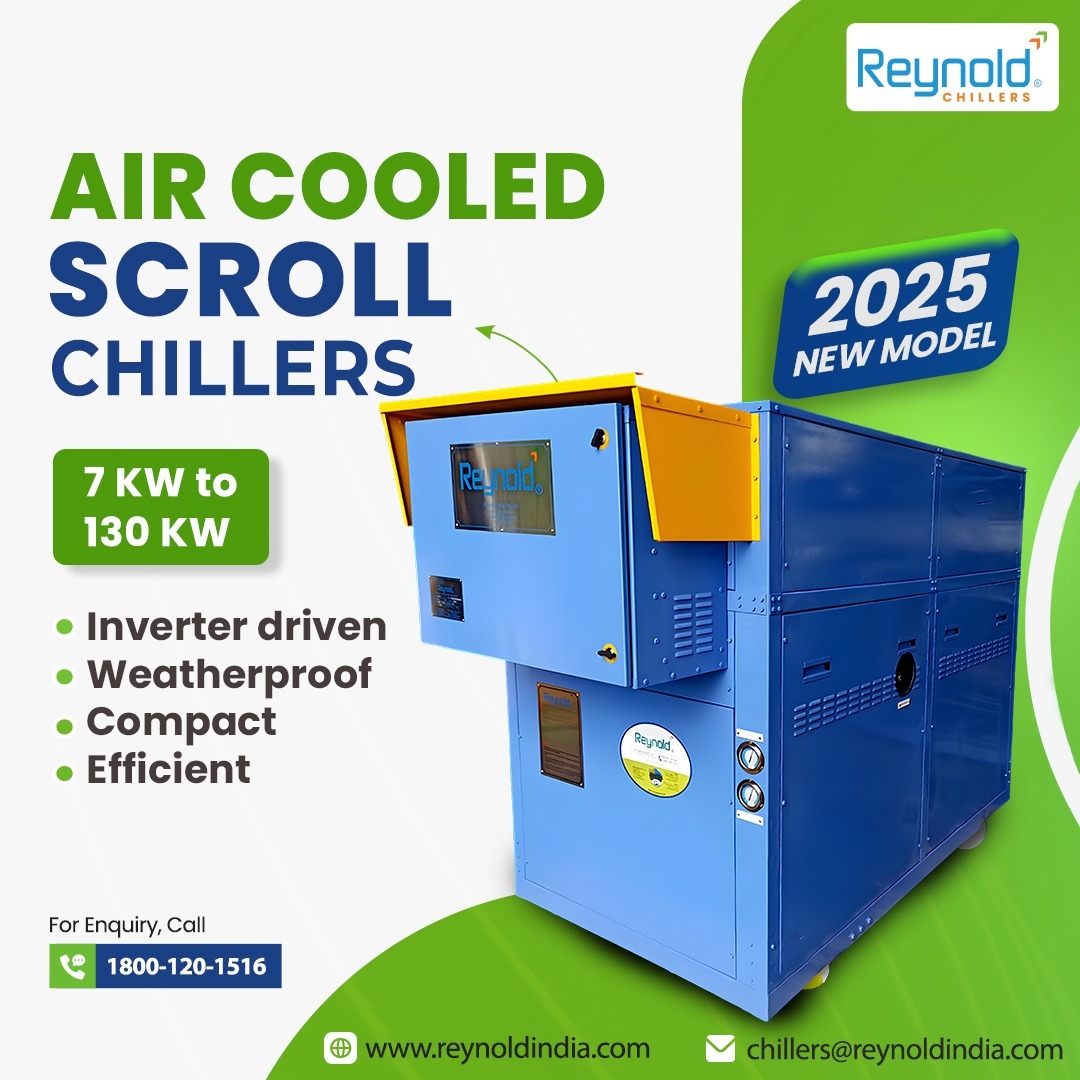
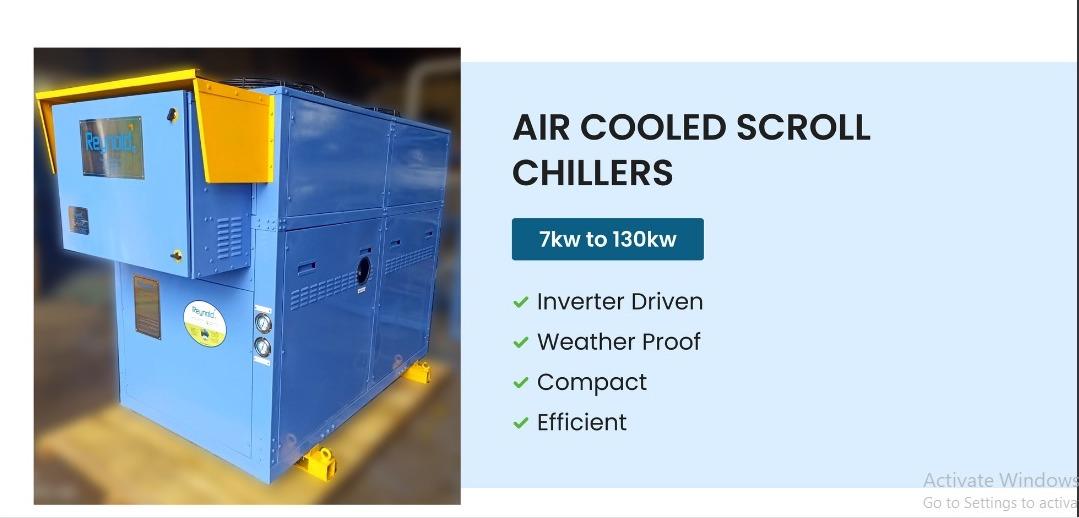
 When an industrial process needs reliable cooling without the complexity of a cooling tower, an Air Cooled Inverter Scroll Chiller can be a practical choice. These chillers are designed to produce chilled water for processes where temperature control, energy efficiency, and dependable operation are important. With inverter technology, the compressor can adjust its speed according to the actual cooling demand instead of operating continuously at full capacity.

1.jpg

What Is an Air Cooled Inverter Scroll Chiller?

An Air Cooled Inverter Scroll Chiller is a refrigeration-based cooling system that uses scroll compressors with variable-speed inverter technology. Unlike water-cooled systems, it rejects heat directly into the surrounding air through an air-cooled condenser.
The inverter-controlled compressor changes its operating speed according to the cooling load. During periods of lower demand, the compressor can reduce its speed, while higher loads require increased capacity. This approach can help reduce unnecessary power consumption and provide more stable chilled-water temperatures.
These chillers are particularly useful for factories, process plants, commercial facilities, and applications where a consistent cooling supply is required throughout the day

How Does an Air Cooled Inverter Scroll Chiller Work?

The cooling process follows the basic refrigeration cycle. Refrigerant absorbs heat from the process water inside the evaporator. The refrigerant then moves to the scroll compressor, where it is compressed and its pressure and temperature increase.
The hot refrigerant travels to the air-cooled condenser, where condenser fans remove the heat and release it into the atmosphere. The refrigerant then passes through the expansion device, reducing its pressure and temperature before returning to the evaporator.
The inverter continuously helps match compressor output with the cooling requirement. This is especially useful when the process load changes during production.

Key Benefits

One of the biggest advantages is better part-load efficiency. Industrial cooling requirements are rarely constant, so variable-speed compressor operation can reduce energy wastage when the required load is lower.
Other important benefits include:
  • Stable chilled-water temperature
  • Reduced compressor cycling
  • Efficient operation under varying loads
  • No cooling tower required
  • Easier installation compared with many water-cooled systems
  • Lower water consumption
  • Compact and practical system configuration
  • Suitable for continuous industrial operation
The actual efficiency and operating cost depend on factors such as ambient temperature, chilled-water temperature, load profile, system design, and maintenance.

Industrial Applications

Air cooled inverter scroll chillers can be used across a wide range of industries. In plastics manufacturing, for example, an Industrial Cooling System for Plastics can provide controlled cooling for injection molding, extrusion, blow molding, and related processes. Consistent cooling is important because fluctuations in process temperature can affect production quality and cycle times.
Concrete production is another area where controlled cooling is important. A concrete chiller can be used to cool mixing water or other materials when concrete temperature needs to be controlled, particularly in hot-weather conditions.

aircooledscrollchillers7kwto130kw.jpeg

Different industrial processes require different cooling technologies. A Cryogenic Hydrogen Gas Chiller, for example, is designed for specialized hydrogen-related cooling requirements and operates under significantly different process conditions from a conventional factory chiller.
Similarly, an RF dryer may require cooling of specific components or process equipment depending on the system design. Water Cooled Screw chillers and an Air Cooled Screw chiller may also be selected for larger industrial loads where higher cooling capacities or different operating conditions are required.
In agricultural and irrigation-related applications, Drip Irrigation Chillers may be considered where controlled-temperature water or specialized process cooling is part of the overall system requirement.

Why Proper Chiller Selection Matters

Choosing a chiller should not be based only on tonnage. The required cooling capacity, inlet and outlet water temperature, flow rate, ambient temperature, operating hours, installation conditions, and process load should all be considered.
For industries with fluctuating cooling requirements, inverter technology can be particularly useful because the system can respond more closely to the actual demand.


1. What is an Air Cooled Inverter Scroll Chiller?

An Air Cooled Inverter Scroll Chiller is a cooling system that uses scroll compressors with variable-speed inverter technology to produce chilled water. The compressor adjusts its speed according to the cooling load, helping the system operate efficiently when demand changes.

2. How does an Air Cooled Inverter Scroll Chiller work?

The chiller removes heat from process water through the evaporator. The refrigerant absorbs this heat, is compressed by the scroll compressor, and then releases the heat through the air-cooled condenser. The cooled water is then circulated back to the industrial process.

3. What are the main benefits of Air Cooled Inverter Scroll Chillers?

The main benefits include variable-capacity operation, good part-load efficiency, stable water temperature, lower water consumption, easier installation, and no requirement for a cooling tower. Actual energy savings depend on the operating conditions and system design.

4. Where are Air Cooled Inverter Scroll Chillers used?

They are used in manufacturing plants, plastics processing, food and beverage production, machinery cooling, HVAC systems, process industries, and other applications requiring reliable chilled-water cooling.

5. Can an Air Cooled Inverter Scroll Chiller be used for plastics processing?

Yes. It can be used as an Industrial Cooling System for Plastics for applications such as injection molding, extrusion, and other plastic-processing operations where consistent process-water temperature is important.

6. What is the difference between an Air Cooled Screw Chiller and an Inverter Scroll Chiller?

Both systems use different compressor technologies. An Air Cooled Screw Chiller is commonly selected for larger cooling loads and continuous industrial applications, while inverter scroll chillers are particularly useful for applications with varying loads where variable-speed operation can improve part-load performance.

7. Is a cooling tower required for an Air Cooled Inverter Scroll Chiller?

No. An air-cooled chiller rejects heat directly to the surrounding atmosphere through its condenser and fans. This eliminates the need for a cooling tower and condenser-water circuit.

8. Can these chillers be used for specialized industrial applications?

Yes, but the chiller must be selected according to the actual process requirements. Specialized systems such as a Cryogenic Hydrogen Gas Chiller, concrete chiller, or cooling associated with an RF dryer may require different temperatures, materials, controls, and refrigeration configurations.

9. Are Water Cooled Screw Chillers better than Air Cooled Inverter Scroll Chillers?

Not necessarily. The right option depends on cooling capacity, operating conditions, ambient temperature, available utilities, installation space, and required efficiency. Water Cooled Screw Chillers can be suitable for large continuous loads, while air-cooled inverter scroll systems can be attractive where cooling-tower infrastructure and water consumption need to be minimized.

10. How do I choose the right industrial chiller?

The selection should consider cooling capacity, required supply and return temperatures, water or fluid flow rate, ambient conditions, operating hours, process load variation, installation environment, and energy requirements. Proper engineering is important for achieving reliable and efficient operation.

11. Can the same cooling technology be used for drip irrigation applications?

Cooling requirements vary by application. Drip Irrigation Chillers should be designed or selected according to the required water temperature, flow rate, environmental conditions, and actual agricultural or process requirement rather than using a standard chiller without evaluation.

12. Why should I choose a customized industrial cooling solution?

Every industrial process has different cooling requirements. A properly engineered solution can be matched to the required capacity, temperature, flow rate, operating conditions, and available space, helping provide more reliable and consistent process cooling.

Conclusion

An Air Cooled Inverter Scroll Chiller offers a combination of reliable cooling, variable-capacity operation, and practical installation. It can be a suitable solution for industries that need accurate temperature control without depending on a cooling tower.
From plastics processing and manufacturing to specialized process applications, selecting the right chiller configuration can improve process stability and overall cooling performance. A properly engineered system should always be selected according to the actual process conditions and required cooling load.

Radio Frequency Dryers: How RF Technology Is Changing Industrial Drying

Drying is one of those processes that looks simple from the outside but can become quite challenging when product quality, drying time, and ...